Intracytoplasmic Sperm Injection, often called ICSI, is a specialised fertility treatment used as part of in vitro fertilisation (IVF). It is designed to help with fertilisation when there are challenges related to sperm quality, sperm count, or previous fertilisation difficulties.
If you are learning about fertility treatments for the first time, ICSI can sound technical and overwhelming. That is completely normal. Most patients do not need to understand the laboratory details right away. What matters most is understanding why it is used, how it fits into your treatment plan, and what it means for your chances of conception.
In simple terms, ICSI involves selecting a single sperm and injecting it directly into an egg in a laboratory setting. This helps increase the chances of fertilisation when natural sperm-egg interaction may not be strong enough.
At Veya Fertility, this treatment is offered as part of a personalised IVF plan when clinically appropriate. The focus is always on clarity, safety, and evidence-based care.
Quick answer:
ICSI is a laboratory technique used during IVF where a single sperm is injected directly into an egg to help achieve fertilisation. It is commonly used when sperm quality or previous fertilisation issues are present.
Key takeaways:
ICSI was developed to help couples who were struggling with fertilisation during traditional IVF cycles. In standard IVF, eggs and sperm are placed together in a laboratory dish and fertilisation happens naturally. However, in some cases, sperm may not be able to penetrate the egg on its own.
ICSI helps overcome this barrier by directly placing the sperm inside the egg.
It may be recommended when:
ICSI is not always required for every IVF cycle. It is used when there is a specific clinical reason.
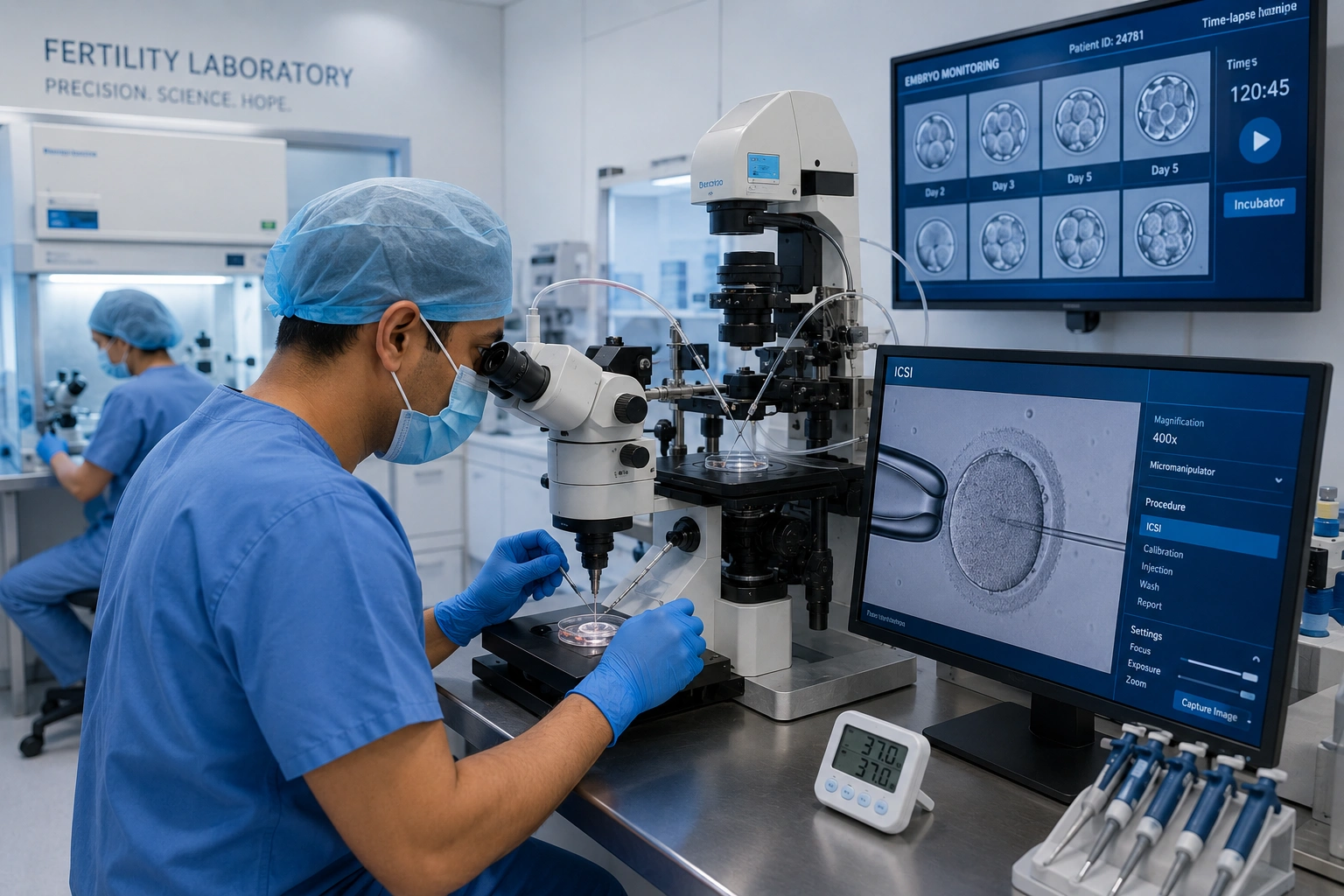
ICSI is performed in a laboratory by highly trained embryologists. It is part of a wider IVF cycle and follows egg retrieval.
Eggs are retrieved from the ovaries after hormonal stimulation.
A sperm sample is collected or retrieved and carefully processed in the lab.
A single healthy sperm is selected under a microscope.
The sperm is injected directly into the egg using a fine needle.
Embryologists observe whether fertilisation occurs successfully.
Fertilised eggs develop into embryos over several days.
This process allows precise control over fertilisation and helps improve outcomes in specific cases.
ICSI and IVF are closely related, but the fertilisation step is different.
ICSI is more controlled and targeted, while IVF relies more on natural fertilisation within a lab environment.
ICSI is not used for every patient. It is recommended based on specific medical findings.
You may be advised to consider ICSI if:
In some cases, ICSI may also be used as a precaution based on clinical judgement.
Learning that you may need ICSI can bring mixed emotions.
You may feel:
These feelings are valid. Many patients feel overwhelmed when moving into advanced fertility treatment, especially when terms are new and technical.
A supportive clinic will explain everything in simple language and guide you step by step so you never feel lost in the process.
ICSI itself is not painful for the patient because it happens entirely in a laboratory. You will not feel the injection of sperm into the egg, as this is performed by embryologists under a microscope.
However, ICSI is part of an IVF cycle, which may involve:
These are typically short-term and manageable with medical support.
ICSI has been widely used for many years and is considered a safe and established laboratory technique.
ICSI improves the chance of fertilisation, but it does not guarantee pregnancy.
Success depends on several factors:
ICSI mainly helps at the fertilisation stage. After that, embryo development and implantation follow similar biological processes as IVF.
It is important to understand that even with ICSI, multiple cycles may sometimes be needed.
While ICSI is widely used, it is still important to understand its limitations.
Your specialist will always explain whether ICSI is appropriate for your situation.
ICSI is not a standalone treatment. It is part of a structured IVF process.
A full IVF cycle with ICSI includes:
Each stage builds towards the goal of creating a healthy embryo for transfer.
After ICSI is performed, embryologists monitor fertilised eggs closely.
They look for:
Embryos may be:
The next step depends on your treatment plan.
Embryologists carefully select a single sperm based on appearance and movement.
They look for:
This selection process is highly detailed and requires advanced training and equipment.
Even when sperm quality is low, embryologists may still find suitable sperm for injection.
While ICSI is a laboratory procedure, lifestyle factors still matter for overall fertility health.
Patients are often encouraged to:
These factors support overall reproductive health and may improve treatment outcomes.
There are many misconceptions about ICSI that can cause unnecessary worry.
Reality: ICSI improves fertilisation but does not guarantee pregnancy.
Reality: It is often used for specific sperm-related issues or previous IVF challenges.
Reality: ICSI does not affect natural fertility in future cycles.
ICSI is not always necessary. In some cases, standard IVF is enough.
Your doctor may recommend IVF without ICSI if:
Choosing between IVF and ICSI depends on clinical evidence, not preference alone.
ICSI may increase the overall cost of IVF treatment because it requires specialised laboratory work.
Costs may depend on:
Clinics should always provide transparent pricing before treatment begins.
The decision to use ICSI is made together with your fertility specialist.
You do not need to decide alone.
Your doctor will consider:
The goal is to choose the approach that gives you the best chance of success while staying medically appropriate.
A supportive clinic plays a key role in your experience.
You should expect:
At Veya Fertility, care is designed to help you feel informed and supported throughout the entire process.
ICSI is a highly specialised fertility technique used during IVF to assist fertilisation when natural processes may not be sufficient. It involves selecting a single sperm and injecting it directly into an egg in a laboratory setting.
While it does not guarantee pregnancy, it can significantly improve fertilisation chances in carefully selected cases.
Understanding this process can help reduce anxiety and give you more confidence in your treatment journey.
Veya Fertility provides evidence-based, compassionate fertility care focused on clarity, safety, and personalised treatment planning.
The main purpose of ICSI is to assist fertilisation by injecting a single sperm directly into an egg. It is used when sperm may not be able to fertilise the egg naturally. This improves the chances of fertilisation in specific medical situations.
ICSI is not better or worse than IVF, but it is different. It is used when there are specific sperm-related issues or previous fertilisation problems. IVF without ICSI is still effective when sperm quality is normal.
No, ICSI does not guarantee pregnancy. It improves fertilisation chances, but other factors such as embryo quality and uterine health also affect success. Multiple cycles may still be needed.
ICSI is considered a safe and widely used fertility technique. Most babies born through ICSI are healthy. In rare cases, additional genetic counselling may be recommended depending on underlying fertility issues.
ICSI is part of an IVF cycle that typically takes several weeks. The fertilisation process itself happens in the lab over a few days. The full cycle includes stimulation, egg retrieval, fertilisation, and embryo transfer or freezing.
If you are reading about ICSI, you may already be in the middle of making important decisions about your fertility treatment. It is completely normal to feel uncertain at this stage. Many patients only begin to understand these options once they are actively planning or starting IVF.
You do not need to decide everything right away. What matters most is having clear information and a care team who explains your options in a simple and honest way. ICSI is one possible step within IVF, and whether it is right for you depends on your individual test results and medical history.
At Veya Fertility, we take time to explain why a treatment is recommended, not just what it is. Our goal is to help you feel informed, supported, and confident in your next step, without pressure or confusion.
If you are unsure about whether ICSI is part of your treatment plan, speaking with a fertility specialist can help clarify your options and what comes next.
If you are ready to explore your fertility options in more detail, you can book a consultation with Veya Fertility today. Our team will guide you through each step with clarity, care, and evidence-based support.
Next step: see every price we charge on our prices page.