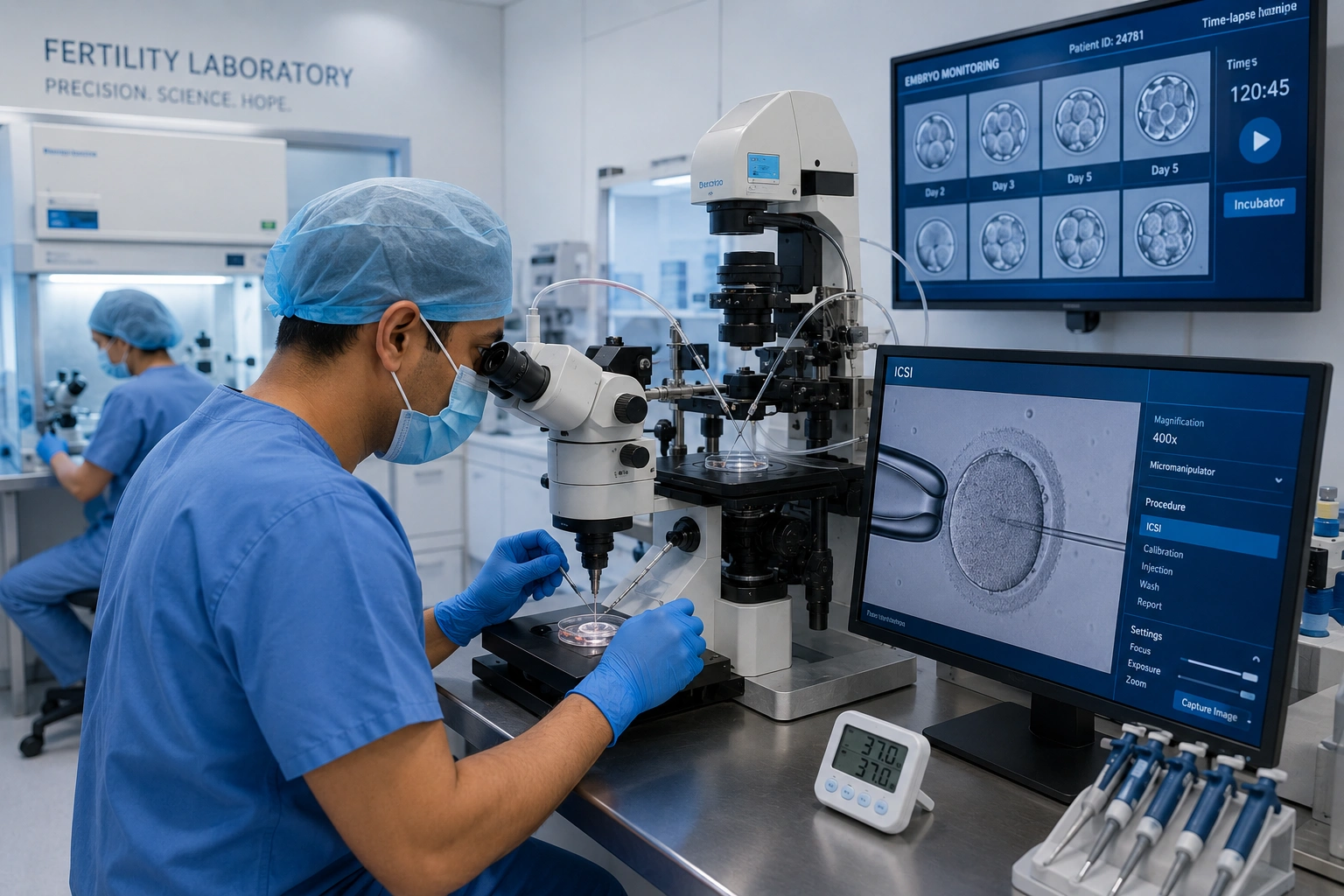
Sperm selection is a critical step in ICSI, as only one sperm is chosen for each egg. Embryologists carefully assess sperm quality under a microscope, focusing on movement, shape, and overall appearance. This precise selection process helps maximise the chances of successful fertilisation.
If you are preparing for IVF with ICSI, you may be wondering how specialists decide which sperm to use. This is an important question, especially given that only one sperm is selected per egg, making the choice feel highly significant.
You might be concerned about sperm quality or curious about how much control the lab has over the process. It is natural to want reassurance that the best possible sperm is being chosen to maximise your chances of success.
Understanding how sperm selection works can help you feel more confident in the science behind your treatment and the expertise guiding your care.
Intracytoplasmic sperm injection is a specialised IVF technique where a single sperm is injected directly into an egg.
Unlike standard IVF, where many sperm compete to fertilise an egg, ICSI relies entirely on the embryologist’s choice. This makes sperm selection a key step in the process.
The quality of the chosen sperm can influence fertilisation and embryo development, although it is only one part of a much bigger picture.
Sperm selection takes place in a highly controlled laboratory environment using advanced microscopy.
Embryologists use both scientific criteria and expert judgement to select the most suitable sperm.
Although sperm are microscopic, trained embryologists can identify key visual indicators of quality.
The goal is to select sperm that appear most capable of supporting normal fertilisation and development.
In some cases, additional techniques may be used to improve sperm selection.
These techniques can help refine the selection process, particularly in complex cases.
Even with careful selection, fertilisation is not guaranteed.
Sperm selection improves the chances of fertilisation but cannot eliminate all uncertainty.
Once the sperm is selected, the ICSI procedure continues.
Sperm selection is just one step in a carefully managed laboratory process.
Several factors can affect how sperm are selected and their potential effectiveness.
The lab team’s skill and the quality of the environment are essential to the process.
It is completely normal to feel anxious about how such an important choice is made. Knowing that only one sperm is selected can make the process feel high-pressure.
However, it may help to understand that embryologists are highly trained specialists who follow strict scientific criteria. Their experience allows them to make informed decisions based on the best available evidence.
Having confidence in your care team can make this part of the journey feel more manageable and less overwhelming.
If you have concerns or want more clarity, it can be helpful to discuss sperm selection with your fertility specialist.
Consider asking if:
Open communication can help you feel more informed and reassured throughout treatment.
In reality, embryologists select the best available sperm, not a perfect one.
Fertilisation and embryo development depend on multiple factors.
While technology supports the process, expert judgement remains essential.
Sperm selection in ICSI is a precise and carefully controlled process designed to support successful fertilisation. While it plays an important role, it is one part of a larger treatment journey that includes egg quality, embryo development, and overall health factors.
Understanding how this step works can help you feel more informed and reassured as you move through treatment. With expert care and the right support, you can approach each stage with greater confidence.
Embryologists examine sperm under a microscope and select one based on movement, shape, and structure. The goal is to choose the healthiest-looking sperm available. This helps improve the chances of fertilisation.
Not all aspects of sperm quality can be seen under a microscope. Some genetic or internal issues may not be visible. This is why fertilisation is not guaranteed.
Not necessarily, although movement is an important factor. Embryologists consider multiple characteristics, including shape and structure. The overall appearance of the sperm is assessed.
If sperm quality is very low, specialists may use alternative techniques or discuss other options. In some cases, viable sperm can still be identified. Your care team will guide the next steps.
Sperm selection can influence embryo development, but it is only one factor. Egg quality and other biological processes also play a major role. Successful outcomes depend on multiple elements.
If you have questions about ICSI or want to understand how sperm selection applies to your situation, speaking with a specialist can provide clarity. A personalised consultation allows you to explore your options and feel supported in your decisions.
Veya Fertility offers expert, compassionate care tailored to your needs. The team is here to guide you through every stage of treatment with transparency and understanding. When you feel ready, you can book a consultation to take the next step.
Next step: see every price we charge on our prices page.